Commercial truck insurance in Fort Worth, TX
Commercial truck insurance in Fort Worth, TX often starts at AllianceTexas, where the BNSF Alliance intermodal facility and a cargo-focused airport feed drayage and dry van work along I-35W and SH-114. BNSF Railway is headquartered in Fort Worth, and plenty of local owner-operators run leased to carriers based near Alliance.
- Licensed
- Texas insurance agency
- Filings
- Form E, BMC-91X, MCS-90
- Writes
- 1 truck to 50-unit fleets
- Office
- Dallas, TX
Fort Worth trucking at a glance
- I-35W
- SH-114
- I-20
- US-287
- BNSF Alliance intermodal
- Drayage
- Livestock
- Hay
- Oilfield work
- Tarrant County hail
- Flash flooding
- Ice storms
- Theft
Leased on with an Alliance carrier
A lot of Fort Worth drivers own the tractor and haul under a motor carrier's authority out of the Alliance area. While you are under dispatch, the carrier usually supplies the auto liability.
That leaves a different set of gaps for you to fill. The carrier's policy follows the load, not the tractor, so the moment you drop a trailer and head home, you are on your own coverage.
Read the lease before you buy anything. It spells out what the carrier provides and what you have to carry yourself, and some carriers make occupational accident coverage a condition of the lease. If you also pull hay or cattle on weekends under your own name, that work falls outside the carrier's policy and needs its own coverage.
Most leased-on Alliance drivers end up with this list:
- Non-trucking liability for personal use and trips when you are not hauling for the carrier
- Physical damage on your own tractor, which your lender will require if it is financed
- Occupational accident coverage when the lease calls for it
Hot shot and flatbed loads west on I-20 to the Permian
The south and west sides of Fort Worth lean toward flatbed, construction, and oilfield work headed out through Weatherford, Abilene, Midland, and Odessa. The Barnett Shale under Fort Worth and nearby counties brought a wave of water trucks, sand haulers, and service trucks in its peak years, and some of that work continues.
Let's break it down. A pickup and gooseneck hauling for hire across state lines needs the $750,000 federal minimum for general freight once the combination is over 10,001 lbs GVWR.
Brokers usually ask for $1,000,000 and $100,000 in cargo. Flatbed operators should read the cargo form for exclusions on unsecured loads.
Radius matters as much as limits. A regular Fort Worth to Permian run is rated differently than a 50-mile job around Tarrant County, so be accurate about how far west your loads usually go. If you run Texas-only oilfield work in a truck over 26,000 lbs, you also need TxDMV authority and a Form E with at least $500,000 in liability.
Cattle and hay out of Stockyards country on US-287
Fort Worth's ranching roots still show at the Stockyards, and the counties around it produce cattle, hay, and grain. Livestock trailers and ag haulers share US-287 and US-377 with semis. Many standard motor truck cargo forms exclude live animals or only pay for death caused by a covered accident, so livestock haulers need a form written for animals.
Tarrant County hail adds to the picture. Large storms here have damaged thousands of vehicles, and a cattle trailer or hay truck parked in an open pasture takes the full hit. Covered parking and a realistic stated value on each unit help when physical damage gets priced.
Fort Worth from Alliance to the Stockyards
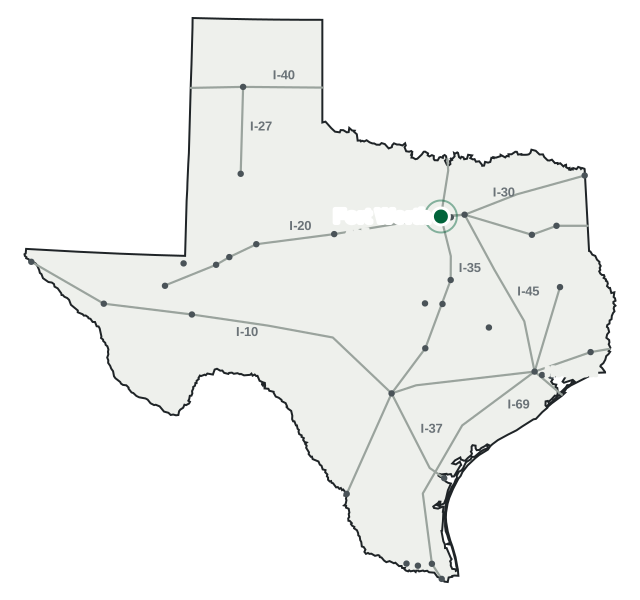
AllianceTexas, on the far north side of Fort Worth, is one of the largest planned logistics developments in the country. It includes Perot Field Fort Worth Alliance Airport, a cargo-focused airport, and the BNSF Alliance intermodal facility. BNSF Railway is headquartered in Fort Worth, and its container and trailer traffic feeds a steady flow of drayage and dry van work along I-35W and SH-114.
I-35W is the north-south spine. It runs from Denton through downtown Fort Worth and on to Hillsboro, where it rejoins I-35E. The stretch near Alliance and the I-820 interchange is one of the more crowded truck routes in North Texas.
I-30 heads east to Arlington and Dallas. I-20 crosses the south side and runs west through Weatherford and on to Abilene, Midland, and Odessa. I-820 loops around the city and ties all of them together.
Union Pacific's Davidson Yard sits on the west side, and there are more rail-served warehouses around the city than most people realize. Arlington, just east, is home to a General Motors assembly plant that pulls in parts loads every day. Centreport, near DFW Airport, adds more warehouse and air cargo freight.
Fort Worth's ranching history is still visible at the Stockyards, and the surrounding counties produce cattle, hay, and grain. Livestock trailers and ag haulers share the road with semis on US-287 and US-377. The Barnett Shale, a natural gas play under Fort Worth and nearby counties, brought a wave of water trucks, sand haulers, and oilfield service trucks in its peak years, and some of that work continues.
The weather is classic North Texas. Spring brings hail, high wind, and the occasional tornado. Tarrant County has seen large hailstorms that damaged thousands of vehicles.
Summer heat pushes tires and cooling systems hard, and winter ice storms can close overpasses with little warning. Flash flooding along the Trinity River and low-water crossings in rural areas is another hazard.
Underwriters weigh all of this. They want to know your garaging ZIP, whether your units are parked under cover, and how far west or north your loads usually run.
Questions truckers ask
Does my Alliance carrier's policy cover me on the weekend?
Usually not. The carrier's auto liability typically applies while you are under its dispatch. Driving your tractor for personal use or for someone else falls outside that, which is what non-trucking liability is for. Physical damage on your own tractor is also your responsibility. Check your lease for anything else the carrier requires, such as occupational accident coverage, and quote all of it together.
Can I get livestock coverage on my Fort Worth policy?
Yes, with the right cargo form. Many standard motor truck cargo policies exclude live animals or limit coverage to death caused by a covered accident. Ask for a form written for animals and confirm which causes of loss it covers, such as overturn, collision, or fire. Tell the agent the species you haul and your typical load value.
Will garaging in Haltom City instead of out near Aledo change my rate?
It can. Insurers rate each truck by the ZIP where it is parked overnight. A tractor in Haltom City or Saginaw faces different theft and traffic patterns than one parked on a ranch outside Aledo, and rates follow. Give the agent the real overnight location for every unit, and mention covered parking if you have it, since Tarrant County hail is part of the pricing.
More coverage for Fort Worth trucks
Nearby areas
Get your trucks quoted
Call and talk it through, or send the short form and an agent calls you back.