West Texas truck insurance for I-10 and I-20 runs
West Texas truck insurance gets priced on miles, and out here a lot of those miles are empty. A truck that drops in El Paso may deadhead hundreds of miles before its next load, at speeds that reach 80 mph on long rural stretches of I-10 and I-20.
- Licensed
- Texas insurance agency
- Filings
- Form E, BMC-91X, MCS-90
- Writes
- 1 truck to 50-unit fleets
- Office
- Dallas, TX
West Texas trucking at a glance
- I-10
- I-20
- US-90
- US-385
- US-285
- Crude oil
- Frac sand
- Cattle
- Hay
- Animal strikes
- Blowing dust
- Hail
- Long tows
Deer, hogs, and loose cattle on US-90 and US-385
Night runs on the two-lane highways south of I-10 are where animals and trucks meet. A cow that slipped a loose fence line can be standing in the lane with no warning, and pronghorn and feral hogs do not wait for headlights to pass.
Mule deer and whitetail move mostly at dawn and dusk, which is exactly when a lot of ranch and oilfield trucks are starting or finishing a shift. Ranch fences run for miles, and cattle and horses wander onto two-lane roads more often than city drivers would guess.
Those claims land on physical damage, not liability. On most policies an animal strike falls under other-than-collision (OTC) coverage rather than collision, which can carry a different deductible. If you carry only liability, a hog through the grille is your bill.
Deadhead legs between Van Horn and Abilene
Underwriters price the miles you run, loaded or empty, because an empty truck can still cause a crash. Radius and annual mileage go on every application.
Estimate them honestly. Low numbers that don't match your logs cause trouble at audit or claim time.
Speed adds weight to every mile, and a wreck at 80 mph costs more. Wind and blowing dust push high-profile trailers around on I-10 and I-20, and spring hail on the Caprock can total a sleeper in minutes. Garaging ZIP still counts, but in rural West Texas the bigger questions are radius, driver history, and what each unit is worth.
Limits follow the work. Auto liability starts at $750,000 for interstate for-hire freight and $500,000 for Texas intrastate trucks over 26,000 lbs, and brokers often want $1,000,000. Cargo is not required by Texas law for general freight, but $100,000 is a common broker ask.
Breaking down between Fort Stockton and Sierra Blanca
Fuel, parts, and heavy wreckers can sit a long way apart on I-10, and cell coverage drops in spots. A blown turbo east of Sierra Blanca can mean a long wait, a long tow, and a load sitting on the shoulder while you wait.
That is why many West Texas operators price towing and rental reimbursement next to liability and physical damage, even though neither is required. Ask the agent how each carrier caps towing, because the distance to the nearest heavy shop changes what a tow costs.
Ranch trucks that haul cattle in spring and hay in fall
Plenty of West Texas operators run a mix. A rancher near Fort Stockton may haul his own cattle to the sale barn part of the year and contract hay loads the rest.
A hot shot driver may jump between oilfield parts and farm equipment. A three-truck fleet in Abilene may run local routes most days and take a long load to El Paso when one comes up.
The policy has to list every kind of load you carry, not just the main one. Livestock is the common gap, because many standard cargo forms exclude live animals. Owner-operators leased to a carrier who use the truck off dispatch need non-trucking liability for those miles.
From Sierra Blanca to Sweetwater on I-10 and I-20
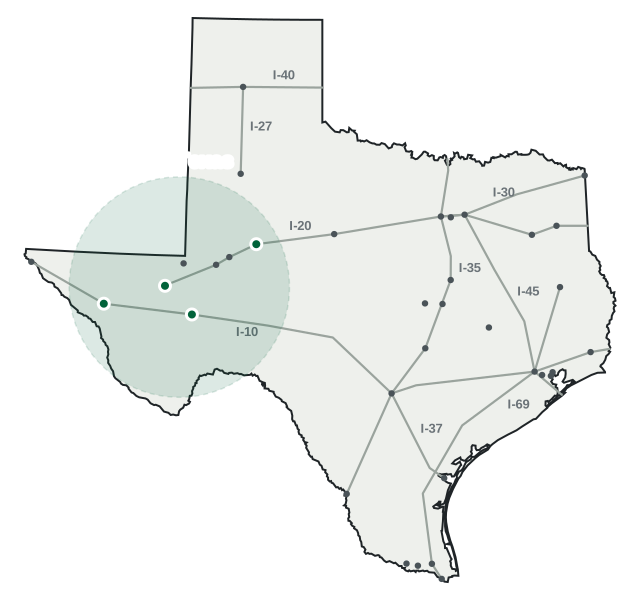
I-10 crosses West Texas from El Paso through Sierra Blanca, Van Horn, Fort Stockton, Ozona, Sonora, and Junction before dropping toward San Antonio. I-20 splits off east of Van Horn and runs northeast through Pecos, Monahans, Odessa, Midland, Big Spring, Sweetwater, and Abilene toward the Metroplex. Speed limits reach 80 mph on long rural stretches of both interstates, and higher speeds make every collision more costly.
Between those towns there is very little. A breakdown that costs an hour in Dallas can cost a day out here, and the nearest heavy wrecker may be several towns back.
North-south routes carry their own freight. US-285 runs from Pecos toward Carlsbad, New Mexico, through Delaware Basin oil country. US-385 links Odessa with Andrews to the north and Fort Stockton and Big Bend to the south.
US-87 connects San Angelo, Big Spring, and Lubbock, and US-277 and US-83 run south from Abilene. Loads on these roads range from crude oil and frac sand to cattle, cotton, hay, and wind turbine parts bound for projects across the region.
Spring brings wind and dust storms that can cut visibility to near zero on I-20 and I-10. Hail hits the Caprock and Permian areas in spring and early summer.
Summer heat stresses tires and cooling systems on loaded trucks. Winter is usually mild, but ice storms and the occasional blizzard can close I-20 and I-27, and freezing fog settles over the plains.
Wildlife is the steady background risk. Mule deer, whitetail, feral hogs, and pronghorn all cross West Texas highways, mostly at dawn and dusk. Ranch fences run for miles and are not always tight, so cattle and horses wander onto two-lane roads too.
Drivers who run nights on US-90, US-67, or US-385 see it often, and many slow well below the posted limit after dark. Those claims hit physical damage, which is one more reason rural operators rarely run on liability alone.
Questions truckers ask
Does deadhead mileage count when I get a quote?
Yes. Underwriters care about total miles and radius, not just loaded miles, because an empty truck can still cause a crash. Give the agent your honest annual mileage and the farthest points you run. If your numbers come in low and your logs later show more, a carrier can adjust your premium at audit or question a claim.
Is a deer strike covered under my truck policy?
Usually, if you carry physical damage coverage. On most policies an animal strike falls under other-than-collision (OTC) coverage rather than collision, which can mean a different deductible. Liability alone will not pay to fix your own tractor. Ask the agent how each carrier handles animal strikes and what deductible applies before you pick a policy.
I run between El Paso and Abilene. Does a rural route help my rate?
It can. Rural garaging ZIPs often price better than dense metro areas for theft and congestion. Long miles at 80 mph, wildlife, and distance from repair shops push the other way. The final number comes from your mileage, driver records, unit values, and loss history. A quote with your real routes is the only reliable answer.
More coverage for West Texas trucks
Nearby areas
Get your trucks quoted
Call and talk it through, or send the short form and an agent calls you back.