Central Texas truck insurance for farm and I-35 haulers
Central Texas truck insurance has to fit harvest season, because the Blackland Prairie between Waco and Temple grows corn, sorghum, wheat, and cotton that leave the field by truck. The same region sits on one of the busiest stretches of I-35 in the state.
- Licensed
- Texas insurance agency
- Filings
- Form E, BMC-91X, MCS-90
- Writes
- 1 truck to 50-unit fleets
- Office
- Dallas, TX
Central Texas trucking at a glance
- I-35
- US-190
- I-14
- SH-6
- US-84
- Grain
- Cotton modules
- Cattle
- Crushed stone
- I-35 work zones
- Hail
- Ice storms
- Deer
Blackland Prairie harvest hauling and farm plates
Harvest can double the work for grain and cotton haulers for a few months, then go quiet. Some operators run farm loads in the fall and broker freight the rest of the year. A truck that switches between farm use and for-hire work may need different filings and coverage at different times, so walk the agent through your whole calendar.
Farm vehicles over 48,000 lbs need a TxDMV number. Hauling for hire changes the rules: you will likely need a USDOT number, intrastate authority, and a Form E with at least $500,000 in liability for trucks over 26,000 lbs.
Cattle operations are spread across the region, and cattle pots need a cargo form written for animals. Grain and hay haulers usually carry auto liability, physical damage, and cargo for the crop. Cotton module trucks and hay haulers share farm-to-market roads with pickups and tractors, and a module truck parked in a field all season still needs a garaging address the agent can rate.
Work zones through Waco and Bell County on I-35
From Hillsboro, where I-35E and I-35W rejoin, the interstate runs through West, Waco, Temple, Belton, and Salado. TxDOT has spent years widening the stretch through Waco and Bell County, and long work zones with narrow lanes and sudden slowdowns are routine. Distribution centers in Temple and Belton, including the McLane Company in Temple, put a lot of trucks into that traffic.
Plenty of long-haul drivers live in small towns from Hillsboro to Belton and run interstate freight from home. Their trucks are rated by the rural ZIP where they park, which often carries a lower base rate than a big-city ZIP.
Radius still counts, so a 500-mile or unlimited operation will price differently from local work. Spring storms in the corridor bring hail, damaging winds, and tornadoes, and winter ice can close I-35 overpasses, so physical damage is worth pricing even on a rural garaging ZIP.
Quarry rock, Killeen growth, and farm-to-market roads
Let's break it down by road. Quarries in Bell, Coryell, and nearby counties supply crushed stone for road building and housing along I-35.
US-190, now partly signed as I-14, links Killeen and Harker Heights to Belton, carrying military contractor freight and suburban growth. Off the highways, farm-to-market roads mean narrow lanes, no shoulders, slow equipment, and deer at night.
A wreck far from a truck stop can mean a long tow, and towing and storage costs add up fast. Ask whether your physical damage coverage includes towing and how much it pays.
Dump truck owners should also price workers' comp, since many general contractors and TxDOT subcontract jobs will not let non-subscribers on site. To the east, SH-6 links Bryan and College Station to Waco and Houston, carrying farm, construction, and delivery traffic.
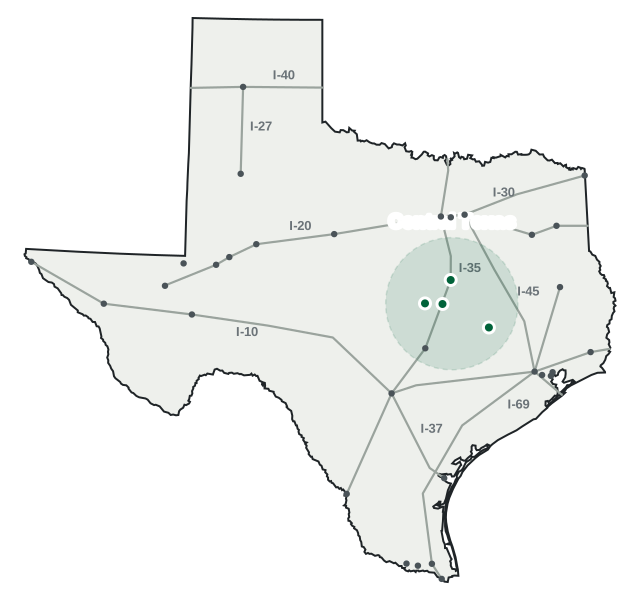
Waco, Temple, Killeen, and Bryan-College Station on the map
I-35 ties the region together. From Hillsboro, where I-35E and I-35W rejoin, the highway runs south through West, Waco, Temple, Belton, and Salado on its way to Austin.
It is one of the busiest truck routes in Texas, and TxDOT has spent years widening and rebuilding the stretch through Waco and Bell County. Long work zones, narrow lanes, and sudden slowdowns are common.
Waco sits at the junction of I-35 with US-84 and SH-6. It is home to Baylor University and a growing number of distribution and manufacturing sites along the interstate.
Temple, to the south, has deep railroad roots and is home to the McLane Company, a large grocery and food service distributor whose trucks run across the region. Belton and Temple both have distribution centers along I-35.
Killeen, to the west, sits next to one of the largest Army posts in the country. US-190 links Killeen, Harker Heights, and Belton to I-35, and part of that route is now signed as I-14. Military and contractor freight, plus fast suburban growth, keep local trucks busy.
Bryan and College Station, home to Texas A&M University, sit to the east along SH-6 and SH-21. The area supports agriculture, research, construction, and a steady flow of delivery traffic. SH-6 connects the area to Waco to the north and to Houston to the south.
Agriculture fills the space between the cities. The Blackland Prairie is some of the most productive farmland in Texas, growing corn, sorghum, wheat, and cotton.
Cattle operations are spread across the region. Grain trucks, hay haulers, cattle pots, and cotton module trucks share farm-to-market roads with pickups and tractors.
Rock is another big commodity. Quarries in Bell, Coryell, and surrounding counties supply crushed stone and base for road building and new housing up and down I-35.
Weather swings hard. Spring storms bring hail, damaging winds, and tornadoes.
Summer heat often tops 100 degrees. Winter ice storms can close I-35 overpasses, and heavy rain can flood low-water crossings and rural roads quickly.
Questions truckers ask
Does my farm truck need a TxDMV number?
Farm vehicles over 48,000 lbs need a TxDMV number. Lighter farm trucks may not, depending on how they are used. If you haul for hire, the rules change, and you will likely need intrastate authority, a USDOT number, and a Form E filing. Ask the agent to review how you use each truck during and after harvest so coverage and filings match.
I live near Waco but run interstate. Where is my truck rated?
Most insurers rate your truck by the ZIP where it is garaged overnight, even if your loads go out of state. A rural Central Texas garaging address can help compared with a big-city one. Radius still matters: a 500-mile radius or unlimited operation will be priced differently from local work. Be accurate about both when you request a quote.
Do I need workers' comp for my Bell County dump truck business?
Texas does not require most private employers to carry workers' comp. But many general contractors and TxDOT subcontract jobs will not let you on site without it. Non-subscribers also lose common-law defenses if an employee sues. If you have drivers or helpers hauling quarry rock, a workers' comp quote is worth getting along with your truck policy.
More coverage for Central Texas trucks
Nearby areas
Get your trucks quoted
Call and talk it through, or send the short form and an agent calls you back.