Commercial truck insurance in San Antonio, TX
Commercial truck insurance in San Antonio, TX has to cover a city that is the first big stop for freight rolling north from the World Trade Bridge in Laredo. I-35, I-10, and I-37 all meet here, and the Eagle Ford Shale sits just south and east.
- Licensed
- Texas insurance agency
- Filings
- Form E, BMC-91X, MCS-90
- Writes
- 1 truck to 50-unit fleets
- Office
- Dallas, TX
San Antonio trucking at a glance
- I-35
- I-10
- I-37
- Loop 410
- Loop 1604
- Border freight
- Auto parts
- Crude
- Limestone and aggregate
- Hail
- Flash flooding
- Wildlife collisions
- Rough lease roads
Laredo border freight rolling north on I-35
Much of the trade crossing the World Trade Bridge heads north on I-35, and San Antonio is where it lands first. Distribution centers on the south and east sides of town take that freight in and send it on toward Austin and Dallas. Toyota's pickup plant on the south side and the suppliers around it add a steady stream of parts loads.
Brokers on the Laredo to San Antonio lanes commonly want $1,000,000 in auto liability and $100,000 in cargo, above the $750,000 federal minimum for interstate general freight. Electronics and auto parts can call for higher cargo limits.
Drivers leased to a motor carrier have a lighter list. The carrier usually supplies auto liability under its own authority, and you cover the gaps with non-trucking liability and physical damage on your own tractor.
Your lease spells out who buys what. Owner-operators who live in the suburbs and run interstate for weeks at a time are still rated by the ZIP where the truck parks at home.
Eagle Ford lease roads in Karnes and Atascosa counties
When drilling is active, flatbeds, hot shots, crude tankers, sand haulers, and water trucks leave San Antonio yards every morning for counties like Karnes, Atascosa, La Salle, and Gonzales. The roads out there are rough. Caliche lease roads are hard on equipment, and wildlife collisions are common at night.
Oilfield work changes the policy. Operators and service companies usually require higher liability limits, general liability, and sometimes pollution coverage. Crude listed as hazmat needs at least $1,000,000.
Many standard trucking forms exclude certain oilfield operations, so a policy written for dry van freight may leave you bare on a lease. If you switch between border freight and oilfield work as the market moves, tell the agent about both. The reverse gap can happen too, when an oilfield policy does not fit general broker freight.
H-E-B reefers, Port San Antonio, and work inside Loop 410
H-E-B is headquartered in San Antonio, and its distribution operations keep reefers and dry vans moving across the region. Port San Antonio, on the old Kelly Air Force Base site, is an industrial and aerospace campus with rail access. Joint Base San Antonio brings government freight and contractor work.
Here is how it works on price. Garaging ZIP comes first, and parts of the city with more theft or traffic carry higher rates than rural areas outside Loop 1604. Local work inside Loop 410 means stop-and-go traffic and tight docks.
Spring hail has damaged thousands of vehicles on the north side, so physical damage rates reflect it. Reefer haulers should ask about reefer breakdown coverage on the cargo form, and dump trucks hauling limestone from quarries near New Braunfels add general liability for job sites.
San Antonio where I-35, I-10, and I-37 meet
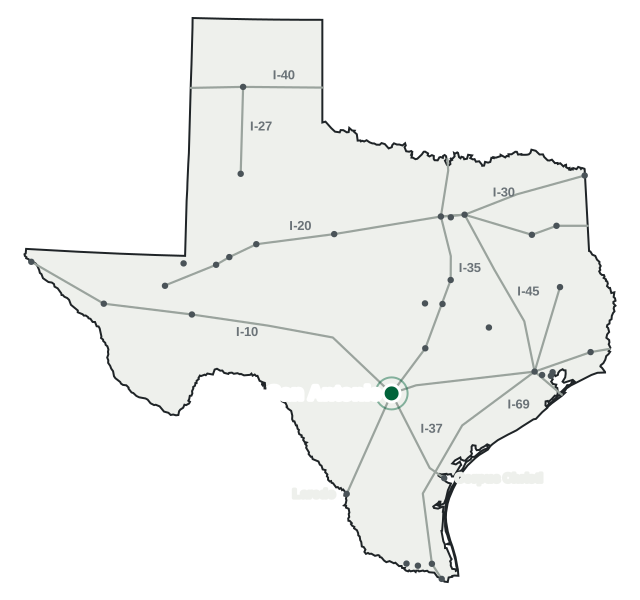
Four interstates meet in San Antonio. I-35 runs north to Austin and Dallas and south to Laredo. I-10 runs east to Houston and west across the Hill Country toward El Paso.
I-37 starts downtown and heads southeast to Corpus Christi. I-410 forms the inner loop, and Loop 1604 makes a wider ring through the suburbs. US-281 runs north toward Johnson City and south toward the Rio Grande Valley, and US-90 heads west toward Del Rio.
I-35 is the freight story. Much of the trade crossing the World Trade Bridge in Laredo heads north on I-35, and San Antonio is the first big city those trucks reach. That means heavy truck volume, distribution centers along the south and east sides of town, and steady work for carriers hauling between Laredo and points north.
Manufacturing is a big part of the local economy. Toyota builds pickup trucks at its plant on the south side, and suppliers around it generate a constant stream of parts loads.
Port San Antonio, on the site of the former Kelly Air Force Base, is an industrial and aerospace campus with rail access. H-E-B, the grocery chain, is headquartered in San Antonio and runs large distribution operations that keep reefers and dry vans moving.
The military is another constant. Joint Base San Antonio includes Fort Sam Houston, Lackland, and Randolph, and bases bring government freight and contractor work.
South and east of the city, the Eagle Ford Shale stretches across counties like Karnes, Atascosa, La Salle, and Gonzales. When drilling is active, flatbeds, hot shots, crude tankers, sand haulers, and water trucks run out of San Antonio yards every morning. Lease roads and county roads in the Eagle Ford are rough, and wildlife collisions are common at night.
To the north, the Hill Country brings quarries, construction, and some of the fastest-growing suburbs in the state. Dump trucks haul limestone and aggregate from quarries near New Braunfels and the north side.
Weather is a mix. Spring hail can be severe, and San Antonio has seen large storms that damaged homes and vehicles across the north side.
Flash flooding at low-water crossings is a regular hazard, and the city posts warnings at many of them. Summer heat routinely tops 100 degrees.
Questions truckers ask
I haul Laredo border freight through San Antonio. What coverage do brokers want?
Most brokers on the Laredo to San Antonio lanes want $1,000,000 auto liability and $100,000 cargo, even though the federal minimum for general freight is $750,000. High-value loads like electronics or auto parts may need higher cargo limits. Physical damage on your tractor and trailer is your call, but lenders require it if the truck is financed.
Do I need special insurance for Eagle Ford oilfield work?
Often, yes. Oilfield operators and service companies usually require higher liability limits, general liability, and sometimes pollution coverage. Many standard trucking policies exclude certain oilfield operations, so tell the agent exactly what you do on location. Crude haulers need at least $1,000,000 for oil listed as hazmat. The agent can quote an oilfield form if your work calls for one.
Will a north side hail claim raise my San Antonio renewal?
Any claim can affect renewal pricing, and hail claims are common here. Weather claims often weigh less than at-fault accident claims, but every carrier rates differently. Pick a deductible you can afford, park under cover when storms are forecast, and keep other claims low. Those steps do the most to protect your rate at renewal.
More coverage for San Antonio trucks
Nearby areas
Get your trucks quoted
Call and talk it through, or send the short form and an agent calls you back.