Commercial truck insurance in El Paso, TX
Commercial truck insurance in El Paso, TX has to fit a border town that sits closer to Phoenix than to Houston. Most of the freight here starts in Ciudad Juarez maquiladoras and crosses at Ysleta-Zaragoza or the Bridge of the Americas before it ever reaches I-10.
- Licensed
- Texas insurance agency
- Filings
- Form E, BMC-91X, MCS-90
- Writes
- 1 truck to 50-unit fleets
- Office
- Dallas, TX
El Paso trucking at a glance
- I-10
- Loop 375
- Ysleta-Zaragoza Bridge
- Bridge of the Americas
- Santa Teresa
- Televisions
- Wiring harnesses
- Auto parts
- Produce
- Blowing dust
- Monsoon flooding
- Cargo tampering
- Inspection violations
Juarez plant freight and the Ysleta-Zaragoza bridge lines
Juarez plants build televisions, wiring harnesses, auto parts, and medical devices. That freight crosses northbound, clears the inspection and customs lots, and lands in warehouses along I-10 and Loop 375 for transloading, cross-docking, or a long run east toward Dallas or west toward Phoenix and Southern California. Southbound trailers haul components and raw materials back to the plants.
Drayage trucks work that loop all day, and the bridge line is where their risk piles up. Trucks idle for hours, loaded and packed close together, which raises the odds of low-speed bumps and cargo tampering.
Port-of-entry inspections are frequent too, and every violation feeds your CSA scores. Underwriters read those scores at each renewal, so clean logs and a well-kept truck count as much as a short radius.
Not every El Paso truck works the bridges. Reefer carriers move produce that crosses at Santa Teresa, flatbeds haul steel and building materials for warehouse construction, and new authorities with fresh USDOT and MC numbers need a first policy before they can book loads.
Short radius still helps. A drayage tractor that stays near the bridges logs far fewer miles than a sleeper running El Paso to Dallas, which is more than 600 miles of I-10 and I-20. The trade-off is congestion, theft attempts, and cargo claims around port yards, which can eat into the savings.
Driving past the bridge into Ciudad Juarez
Most U.S. truck policies do not cover driving in Mexico. If your truck goes past the bridge into Juarez, you need Mexican liability coverage from a Mexican-licensed insurer, bought separately, by the trip or by the year. Ask about it before your first southbound load.
Tell the agent exactly where each truck turns around. A fleet with one unit that crosses and four that never do only needs the Mexican policy on the one that goes south.
On this side of the river, interstate for-hire carriers need at least $750,000 in auto liability, though most brokers want $1,000,000. Texas does not require cargo coverage for general freight, but $100,000 is a common broker ask. Owner-operators leased to a motor carrier often add non-trucking liability for time off dispatch.
Van Horn dust, monsoon arroyos, and Mountain Time logs
Out here the weather risk is wind, not hurricanes. Spring westerlies throw dust across I-10 between El Paso and Van Horn, and empty high-profile trailers take the worst of it.
Summer monsoon storms dump short, heavy rain that floods arroyos, underpasses, and low crossings. Physical damage on the tractor and trailer is what pays when either one catches you.
El Paso also runs on Mountain Time, an hour behind most of Texas. The clock does not change your price, but drivers logging hours across the time zone line need tidy ELD records.
Past that, the usual factors carry the weight: CDL experience, MVR, years in business, commodity, unit values, and loss runs. That holds for reefer carriers moving produce through Santa Teresa and for flatbeds hauling steel to warehouse construction on the east side.
El Paso from Loop 375 to the Santa Teresa port
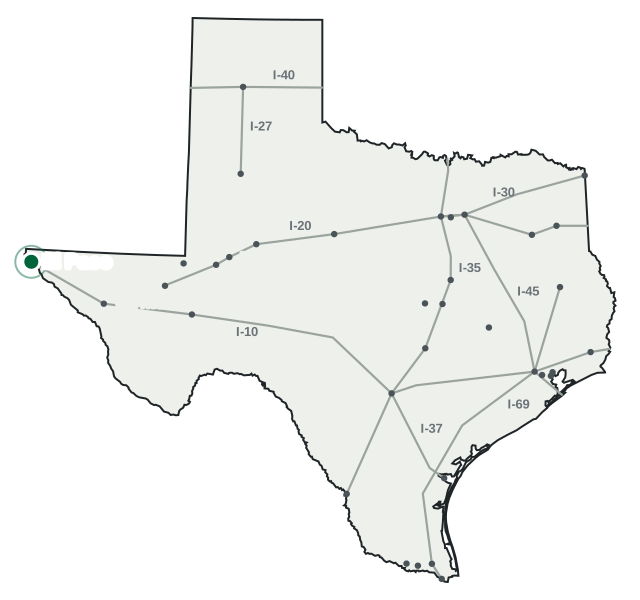
El Paso sits at the far west tip of Texas, closer to Phoenix than to Houston. I-10 is the spine.
It enters from Las Cruces, New Mexico, runs through downtown, and heads east toward Van Horn, where I-20 splits off toward the Permian Basin. Loop 375 wraps around the east and north sides of the city, US-54 (the Patriot Freeway) runs north toward Alamogordo, and US-62/180 heads east toward Carlsbad and the Delaware Basin oilfields.
Two bridges carry most commercial truck traffic. The Ysleta-Zaragoza International Bridge on the east side handles a large share of northbound trucks from Juarez industrial parks, and the Bridge of the Americas near downtown also processes commercial loads.
Trucks come off the bridges into inspection and customs lots, then fan out to warehouses along I-10 and Loop 375. A short run west, the Santa Teresa port of entry in New Mexico gives carriers another option, and the Union Pacific intermodal terminal at Santa Teresa pulls container freight through the region.
The freight mix follows the maquiladora economy. Juarez plants assemble televisions, wiring harnesses, auto parts, and medical supplies, and much of it moves north in dry vans and reefers. That means plenty of short-haul drayage, transload work, and cross-dock moves, plus long-haul tractors heading toward Dallas, Phoenix, and Los Angeles.
Southbound trailers carry raw materials and components back to the plants. Construction hauling stays busy too, with dump trucks and flatbeds serving new development on the east and northeast sides of town.
Wind is the weather story here. Spring brings strong westerly winds and blowing dust, and visibility on I-10 between El Paso and Van Horn can drop quickly. Empty high-profile trailers are the most exposed.
Summer monsoon storms bring short, heavy rain that can flood arroyos, low crossings, and underpasses. Winters are mild, but the occasional winter storm can slow traffic on I-10 east of town.
El Paso runs on Mountain Time, an hour behind most of Texas. Drivers who log hours across the time zone line should keep clean ELD records, because underwriters review inspection history at renewal.
Questions truckers ask
Does my Texas truck policy cover me in Ciudad Juarez?
Most U.S. truck policies do not cover driving in Mexico. Liability coverage that Mexican authorities will accept has to come from a Mexican-licensed insurer, and you buy it separately, often by the trip or by the year. If you only drop trailers at the bridge or work on the U.S. side, your U.S. policy applies. Tell the agent exactly where your trucks go.
Do drayage trucks that stay near the bridges pay less?
Often, but not always. A short radius cuts mileage and long-haul exposure, which usually helps. Bridge lots and port traffic add congestion, theft, and cargo risk, which can offset part of that. Your garaging ZIP, driver records, and claims history matter just as much. The only way to know is to get quoted with your actual radius and routes.
I am a new authority in El Paso. Can I still get a quote?
Yes. Many carriers write new authorities, though choices are narrower and pricing runs higher until you build a track record. Underwriters look hard at CDL experience, and two or more years is a common line. If your first contracts are bridge drayage, say so, because port-of-entry inspection history follows you into every renewal. The agent will tell you what each carrier wants before it files your BMC-91X.
More coverage for El Paso trucks
Nearby areas
Get your trucks quoted
Call and talk it through, or send the short form and an agent calls you back.