Commercial truck insurance in Houston, TX
Commercial truck insurance in Houston, TX gets priced with water in mind, because the city is flat, takes heavy rain, and can flood underpasses and low roads within an hour. Hurricane Harvey in 2017 flooded large parts of the metro and damaged a huge number of vehicles, and underwriters still ask where your trucks park.
- Licensed
- Texas insurance agency
- Filings
- Form E, BMC-91X, MCS-90
- Writes
- 1 truck to 50-unit fleets
- Office
- Dallas, TX
Houston trucking at a glance
- I-10
- I-45
- 610 Loop
- Beltway 8
- Port Houston
- Pipe and steel
- Fuel and chemicals
- Groceries and imports
- Containers
- Flash flooding
- Hurricanes
- Cargo theft
- Stop-and-go traffic
Low yards and flooded underpasses after Harvey
A truck in a low-lying lot is more exposed than one parked on higher ground, and insurers price that through your garaging ZIP. Flood damage to your own truck usually falls under the other-than-collision part of physical damage, but forms vary, so confirm flood is a covered cause of loss on the quote itself.
Plan around the weather you can see coming. When heavy rain is in the forecast, move trucks to higher ground and keep drivers out of flooded underpasses. Hurricane Ike in 2008 and Hurricane Beryl in 2024 brought wide wind damage and power outages too, so set up coverage well before hurricane season gets busy rather than when a storm is already in the Gulf, since insurers often stop writing new coverage or raising limits once a named storm approaches the coast.
Hours, not miles, on the Katy Freeway and the 610 Loop
Houston is laid out in rings and spokes, and the distances inside them are long. A local route from the Energy Corridor on west I-10 to Pasadena can take most of a morning.
A box truck running Katy to Kingwood might log more hours than miles. Underwriters care about both, so tell the agent how your trucks spend their day, not just the radius on paper.
Here is how it works on the pricing side. Each unit is rated by garaging ZIP, and Houston ZIPs differ on theft as much as on flood.
Cargo theft and trailer theft are concerns in some parts of the metro. Long stretches of stop-and-go on I-10, I-45, I-69/US-59, and the 610 Loop raise accident exposure, and interchange rebuilds on I-45 keep lane closures in the mix.
Fewer markets write new ventures in hazmat and tank work, so a new authority should say so up front. A fenced yard, drivers with clean MVRs, and loss runs that show few claims all count in your favor.
Pipe, fuel, and groceries: the Houston commodity list
What you haul moves your limits more in Houston than in most Texas cities. General freight carriers need $750,000 federally, and brokers usually want $1,000,000.
Oil and many hazardous materials require $1,000,000, and certain bulk hazmat requires $5,000,000. Texas intrastate placarded oil and petroleum haulers need $1,000,000 on file with TxDMV.
Each kind of Houston freight adds its own coverage:
- Flatbeds hauling pipe, steel, and equipment for the energy business: cargo limits that match load values
- Reefers moving imports and groceries across the metro: reefer breakdown coverage on the cargo form
- Tankers on fuel and chemical runs: pollution coverage, which many shippers require
- Crews working inside refineries and plants: workers' comp, since many plant contracts require it even though Texas lets most employers opt out
Houston's loops, spokes, refineries, and rain
Houston is laid out in rings and spokes. The 610 Loop circles the inner city. Beltway 8, the Sam Houston Tollway, forms the next ring.
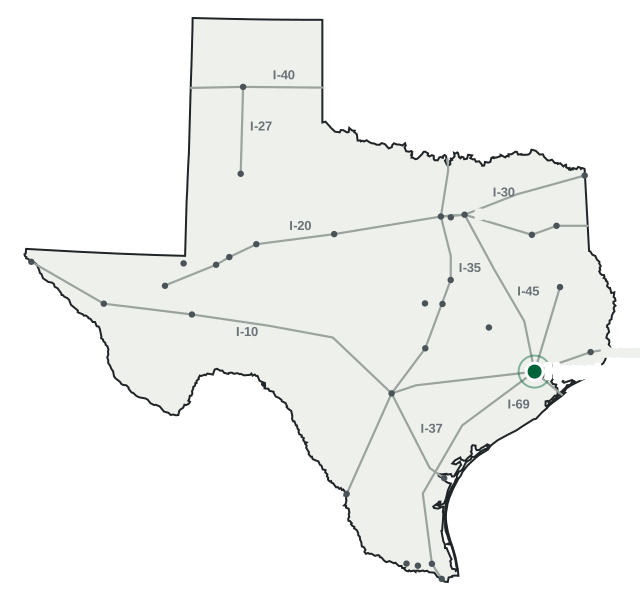
SH-99, the Grand Parkway, is the outer loop and keeps growing. Spokes run in every direction: I-10 east toward Beaumont and west toward San Antonio as the Katy Freeway, I-45 north to Dallas and south to Galveston, I-69/US-59 northeast toward Lufkin and southwest toward Victoria, US-290 northwest toward Austin, and SH-288 south toward Freeport.
Truck traffic on those roads is heavy and steady. The Katy Freeway, the North Freeway, and the Southwest Freeway all see long stretches of stop-and-go traffic during rush hours.
Major interchange rebuilds have been underway on I-45 and around downtown. Expect lane closures and detours to be part of the job.
Port Houston anchors the east side. Container trucks run between the Barbours Cut and Bayport terminals and warehouses along Beltway 8, I-10, and SH-225.
Union Pacific and BNSF rail yards on the east and north sides add intermodal drayage. George Bush Intercontinental Airport generates air cargo work on the north side.
Energy and chemicals set Houston apart. Refineries and petrochemical plants line the Ship Channel, Baytown, Pasadena, Deer Park, and Texas City.
That work calls for tankers, flatbeds hauling pipe and plant equipment, and hazmat-qualified drivers. The Energy Corridor along west I-10 houses many oil and gas company offices, and the oilfield supply business keeps flatbeds and hot shots running to South Texas and beyond.
Weather is a big part of the risk. Houston is flat and gets heavy rain, so flash flooding is common on freeways and underpasses. Hurricane Harvey in 2017 flooded large parts of the metro and damaged a huge number of vehicles.
Hurricane Ike in 2008 and Hurricane Beryl in 2024 caused widespread wind damage and power outages. Summer heat and humidity are hard on tires, batteries, and reefer units.
When an underwriter sees a Houston garaging ZIP, they think about flood exposure, traffic, theft, and the commodities you haul. Be ready to discuss each one.
Questions truckers ask
Is my truck covered if a Houston storm floods my yard?
Usually, if you carry physical damage. Flood is normally handled under the other-than-collision part of the policy, but forms vary, so read the covered causes of loss before you sign. Liability alone does not pay to repair or replace your own truck. Set a stated value that matches what the unit is really worth, since that caps what a total loss pays.
I haul fuel around Houston. What liability limit do I need?
Interstate carriers hauling oil listed in the federal hazmat table need at least $1,000,000. Texas intrastate carriers hauling oil or petroleum hazmat that requires placards also need $1,000,000 on file with TxDMV. Many refineries and terminals around Houston require more than the minimum and add pollution coverage requirements. Send your shipper contracts to the agent so the quote matches them.
Do refinery and plant contracts require workers' comp?
Many do. Texas lets most private employers choose not to carry workers' comp, but plants and large contractors around Houston often require it before you can work on site. Non-subscribers also lose common-law defenses if an employee sues over an injury. If you have employees or plan to bid on plant work, ask for a workers' comp quote along with your auto policy.
Is cargo insurance required for Houston carriers?
Texas does not require cargo insurance for general freight carriers by law. Out on the road, almost every broker and shipper asks for it, commonly at $100,000. Reefer haulers moving food out of Houston warehouses should ask about reefer breakdown coverage, and high-value imports from Port Houston may need higher limits. The agent can quote cargo limits that match your loads.
More coverage for Houston trucks
Nearby areas
Get your trucks quoted
Call and talk it through, or send the short form and an agent calls you back.