East Texas truck insurance for logging and gas
East Texas truck insurance is shaped by the log truck, which is one of the harder classes to place because many insurers will not write it. Pine from the Angelina and Davy Crockett National Forests moves to sawmills, chip mills, and paper plants around Lufkin and Nacogdoches on US-59 and US-69.
- Licensed
- Texas insurance agency
- Filings
- Form E, BMC-91X, MCS-90
- Writes
- 1 truck to 50-unit fleets
- Office
- Dallas, TX
East Texas trucking at a glance
- I-20
- I-30
- US-59
- US-69
- Loop 323
- Pine logs
- Finished lumber
- Pipe
- Poultry feed
- Shifting log loads
- Fallen trees
- Morning fog
- Muddy lease roads
Placing a log truck account in the Piney Woods
Here is why logging costs what it does. Log trucks run heavy on narrow rural roads, pull out of woods roads into highway traffic, and work around loaders and skidders. Loads can shift.
With fewer markets competing, the carriers that do take the class want years in business, trained drivers, and clean loss runs. A brand-new outfit will see fewer options.
Equipment age changes the math. An older log truck or trailer may be worth less than the deductible on a physical damage claim, so some contractors carry liability only on those units. Newer trucks under a loan need physical damage to satisfy the lender.
Intrastate log trucks over 26,000 lbs need $500,000 in liability with a Form E at TxDMV. Cargo coverage for lumber, poles, and finished wood products, plus workers' comp that many mills require, round out a typical account. Tell the agent whether your trucks are loaded in the woods and which mills they deliver to, since underwriters ask.
Haynesville pads around Carthage and Marshall
The Haynesville Shale lies under Panola, Harrison, Shelby, and San Augustine counties. When drilling picks up, water trucks, sand haulers, pipe flatbeds, and hot shots run out of Carthage, Marshall, and nearby towns, and the lease roads turn rough and muddy after rain.
Gas operators and service companies often require higher liability limits, general liability, and sometimes pollution coverage before you can work on location. Crude or other listed hazmat loads need at least $1,000,000.
Standard trucking forms may exclude some oilfield work, so a contractor who moves a truck from logs to the gas field needs to say so before it happens. General liability for work on location and physical damage on the units that run the pads are the usual additions.
Crossing into Louisiana and Arkansas on I-20 and I-30
I-20 runs from Dallas through Tyler's north side, Longview, and Marshall into Louisiana toward Shreveport. I-30 runs through Mount Pleasant to Texarkana.
Any for-hire load that crosses either line makes you an interstate carrier: an MC number, a BMC-91 or BMC-91X filing, a BOC-3, UCR registration each year, and at least $750,000 in liability for general freight. Brokers usually want $1,000,000, and $100,000 in cargo is a common ask on those lanes.
Rural ZIPs often see less theft and congestion than big cities, but two-lane highways with no shoulders, morning fog, deer, and slow equipment add their own risk. Poultry feed and live haul trucks around Mount Pleasant and Pittsburg share those same roads. Spring storms, ice that brings down pines, and hurricane remnants that push inland can leave fallen trees across a rural route, which is a real hazard for a loaded truck before daylight.
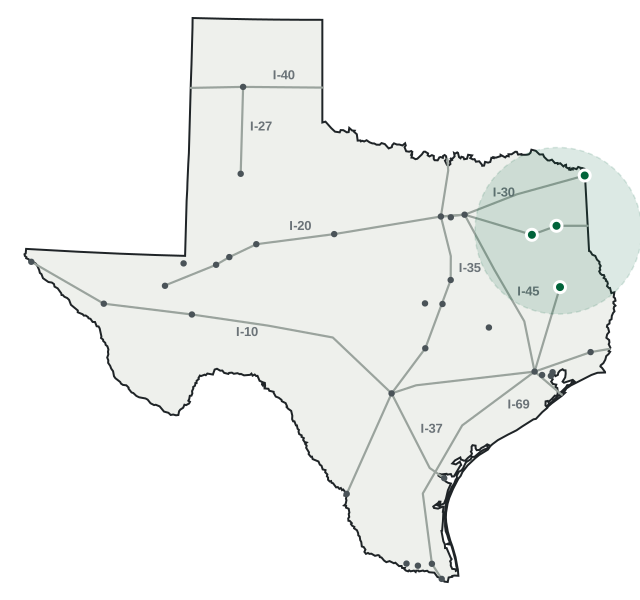
Tyler, Longview, Lufkin, and the Haynesville on one map
I-20 is the main freight corridor through East Texas. It runs east from Dallas through Canton, Lindale, Tyler's north side, Kilgore, Longview, and Marshall before crossing into Louisiana toward Shreveport. Truck traffic is heavy all day.
I-30 runs farther north through Mount Pleasant to Texarkana, which straddles the Texas-Arkansas line. US-59, part of the planned I-69 corridor, runs from Texarkana south through Marshall, Carthage, Nacogdoches, and Lufkin toward Houston.
Tyler is the largest city in the region. Loop 323 circles the city, and US-69 and US-271 run north and south.
Tyler is known as the Rose Capital of America, and its health care and retail sectors keep delivery fleets busy. Longview, to the east, is an industrial town with chemical manufacturing, including a large Eastman Chemical plant, plus rail yards and steel and equipment fabrication.
Lufkin and Nacogdoches anchor the southern Piney Woods. The forests around them, including the Angelina and Davy Crockett National Forests, support logging, sawmills, and wood products plants.
Log trucks are a constant presence on US-59, US-69, and the state highways that cross the region. Pine logs, pulpwood, chips, and finished lumber all move by truck.
Gas drilling is another big industry. The Haynesville Shale lies under parts of East Texas and northwest Louisiana, especially around Panola, Harrison, Shelby, and San Augustine counties.
When drilling is active, water trucks, sand haulers, pipe flatbeds, and hot shots run out of Carthage, Marshall, and nearby towns. Lease roads can be rough and muddy after rain.
Agriculture adds poultry, cattle, and hay. Northeast Texas around Mount Pleasant and Pittsburg has large poultry operations, which keep feed trucks and live haul trucks moving.
Weather is wetter than the rest of Texas. Heavy rain, flash flooding, and fog are common. Severe storms and tornadoes hit in spring.
Ice storms can coat pine trees and power lines and close roads. Hurricane remnants sometimes push inland with heavy rain and wind, and fallen trees across rural roads are a real hazard.
Questions truckers ask
Why is log truck insurance hard to find in East Texas?
Many insurers do not write logging at all, so fewer companies compete for the business. Log trucks run heavy on rural roads, pull out of woods roads into traffic, and haul loads that can shift. The markets that do write it want years in business, experienced drivers, and clean loss runs. Logging accounts can take longer to place, so start early before a renewal or contract date.
Do Haynesville gas operators require special coverage?
Many do. Operators and service companies often require higher liability limits, general liability, and sometimes pollution coverage before you can work on location. Standard trucking policies may exclude some oilfield work, so describe your operations clearly. Crude or other listed hazmat loads need at least $1,000,000 in liability. The agent can quote an oilfield form if your work calls for one.
I run I-20 from Tyler to Shreveport. Am I interstate?
Yes. Any for-hire load that crosses into Louisiana makes you an interstate carrier. That means an MC number, a BMC-91 or BMC-91X filing, a BOC-3, and UCR registration each year, plus at least $750,000 liability for general freight. If you also run Texas-only loads, you may want TxDMV authority too. The agent can help sort out both sets of filings.
More coverage for East Texas trucks
Nearby areas
Get your trucks quoted
Call and talk it through, or send the short form and an agent calls you back.