Commercial truck insurance in Odessa, TX
Commercial truck insurance in Odessa, TX is mostly about heavy iron. Fabrication shops, pipe yards, and service companies line I-20 and Loop 338, and their winch trucks, lowboys, and vacuum units run west to the Delaware Basin as often as east into the Midland Basin.
- Licensed
- Texas insurance agency
- Filings
- Form E, BMC-91X, MCS-90
- Writes
- 1 truck to 50-unit fleets
- Office
- Dallas, TX
Odessa trucking at a glance
- I-20
- Loop 338
- US-385
- SH-302
- SH-18
- Rigs and pumps
- Frac sand
- Produced water
- Crude
- Oversize loads
- Oilfield yard theft
- Fatigue
- Deer and feral hogs
Lowboys and wide loads leaving Loop 338
Rigs, pumps, tanks, separators, and skids move from Ector County yards to well pads, and many of those moves are oversize, with permits, escorts, and careful routing around low lines and narrow bridges. Underwriters ask how often you run oversize or overweight and what you haul, because a crash with a wide load can be severe. Frequent heavy-haul work usually prices higher than standard flatbed freight, and oilfield and heavy-haul contracts often ask for $1,000,000 in auto liability.
Rig moves are slow, heavy, and often scheduled at odd hours to stay out of traffic. That puts lowboys and escorts on Loop 338, US-385, and SH-302 at dawn, when commuter pickups and school buses are already on the road. Documented route surveys and a written safety program help when an underwriter asks how you plan those moves.
Unit value is the other big number. A winch truck, a lowboy trailer, or a vacuum truck carries a high stated value, and physical damage premiums follow it. Set those values carefully, because the stated value is what a total loss is measured against.
Hauling someone else's drilling motor or pump
Customer equipment is where generic trucking forms fall short. Some motor truck cargo policies cap coverage on machinery or exclude high-value items, and some only cover listed commodities.
If you haul a customer's drilling motor or pump, tell the agent what it is worth and how it is secured. You may need higher cargo limits or a rigging or inland marine form.
Work off the truck is a separate exposure. Auto liability covers the truck on the road.
Rigging, hooking up hoses, and unloading on location can fall outside it, which is why most Permian operator contracts ask for general liability too. Share the contract so both policies line up.
Yard security on I-20 and the road to Kermit
Expensive equipment sits in gravel yards along I-20, Loop 338, and the highways toward Kermit and Andrews, and theft from oilfield yards is a known problem. Fencing, lighting, and cameras help your case.
Odessa fleets tend to be small and specialized: a two-truck winch outfit, a five-unit vacuum operation, a single lowboy owner-operator. Heavy and oilfield risks go to a smaller group of carriers, and not every carrier will look at them. A policy that lists the right equipment and commodities avoids gaps when a claim comes in.
Vacuum truck operators face their own questions. Fresh water and produced water each sit in their own rating class, and placarded crude and petroleum loads carry a $1,000,000 minimum. If one vacuum unit hauls more than one kind of fluid, the policy has to name each commodity.
Night shifts on narrow two-lane roads mean fatigue and close calls with oncoming tankers. Drivers with clean MVRs and several years of CDL experience still get the best options.
Ector County yards, sand mines, and SH-302
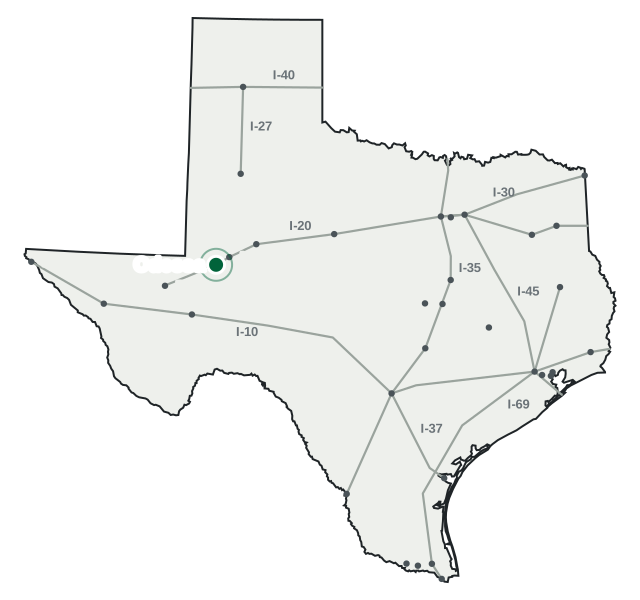
Odessa sits on I-20 in Ector County, on the western half of the Midland-Odessa area. Loop 338 circles the city and carries much of the truck traffic between I-20 and the industrial areas on the north and west sides. US-385 runs north to Andrews and south to Crane.
SH-302 heads west through Notrees to Kermit and on to Mentone in Loving County. Those routes tie Odessa yards to the Central Basin Platform under the city and to the Delaware Basin farther west.
The local economy leans industrial. Fabrication shops build tanks, separators, and skids. Pipe yards stage tubulars for drilling programs.
Service companies keep rigs, pumps, and frac equipment in big gravel yards along I-20 and the loops. Heavy-haul carriers move that equipment between yards and well pads, and many of those moves are oversize, with permits, escorts, and careful routing around low lines and narrow bridges.
Frac sand changed hauling here. Mines in the sand hills around Kermit and Monahans now supply much of the sand used in the basin, which put pneumatic and belly-dump sand trucks on SH-302, SH-18, and county roads in large numbers.
Water hauling did the same. Produced water moves from wells to disposal sites, and fresh water moves to frac jobs, much of it by vacuum and tank truck, though pipelines now carry part of that load.
Ector County roads carry an odd mix. Commuter pickups, school buses, sand trucks, crude tankers, and wide loads all share the same two-lane highways, and many rural roads have soft shoulders and little lighting. Shift changes at dawn and dusk stack that traffic up, right when deer and feral hogs are moving.
Spring wind storms throw dust and sand across Loop 338 and I-20, and visibility can fall fast. Hail hits in spring and early summer.
Summer highs regularly top 100 degrees, which is hard on tires and brakes for loaded heavy-haul units. In winter, the rare ice storm can strand trucks on overpasses and lease roads.
Questions truckers ask
Do sand trucks out of the Kermit and Monahans mines price differently from flatbeds?
Usually. Fresh water, produced water, crude, sand, and drilling equipment each sit in a different rating class, so a pneumatic sand trailer and a flatbed hauling pipe get priced on different terms. Sand hauls are short but frequent, and SH-302 and SH-18 are crowded two-lane roads. Tell the agent exactly what each unit hauls so it lands in the right class.
What limits do I need for placarded crude out of Odessa?
Oil and petroleum loads that require placards carry a $1,000,000 minimum. That applies under TxDMV rules for intrastate runs and under federal rules for listed oil hazmat moving interstate. Many operator contracts ask for that same $1,000,000 or more, sometimes with an umbrella on top. Tell the agent which loads are placarded so the limits match the filing.
I run a two-truck winch outfit. Will carriers even quote me?
Yes, though the field is narrower. Heavy equipment and oilfield exposures go to a smaller group of carriers, and each one wants a full picture first: what the units are worth, how often you run oversize, who sits behind the wheel, and your loss runs. Small Ector County outfits get written every day. A complete, accurate request gets you real numbers faster.
More coverage for Odessa trucks
Nearby areas
Get your trucks quoted
Call and talk it through, or send the short form and an agent calls you back.